Other Invasive Citrus Pest and Disease Threats
While the Asian citrus psyllid (ACP) and Huanglongbing (HLB) continue to be among the biggest threats to California citrus trees, there are several other invasive pests and diseases that could have significant impacts on your homegrown citrus.
These invasive pests and diseases – including invasive fruit flies, Citrus yellow vein clearing virus, sweet orange scab and more – have the potential to harm your citrus trees and even ruin the fruit, making it inedible.
California residents play a key role in mitigating these pests and diseases and should be aware of the latest information that may impact homegrown citrus. Together, we can safeguard the future of California citrus. Below is a list of resources for other notable pest and disease threats. If you have any questions, please submit your inquiry via our contact form.
Citrus Yellow Vein Clearing Virus (CYVCV)

Citrus yellow vein clearing virus (CYVCV) is an emerging disease of citrus that can cause your citrus trees to die-back and fruits may be malformed.
CYVCV can be spread by vectors as they move from tree to tree feeding on foliage. The vectors include citrus whitefly, green citrus aphid, melon or cotton aphid, and cowpea aphid, which are all known to be present in California. CYVCV can also be spread through grafting and the movement of infected propagative materials and rootstocks, and contaminated tools and equipment. While there is no treatment for CYVCV, as of now, the best mitigation measures are to control the virus’ vectors and sanitize gardening tools and equipment. To the greatest extent possible, residents are encouraged to clean and sanitize all their gardening equipment thoroughly in between use or when using at other residential properties.
Sweet Orange Scab (SOS)
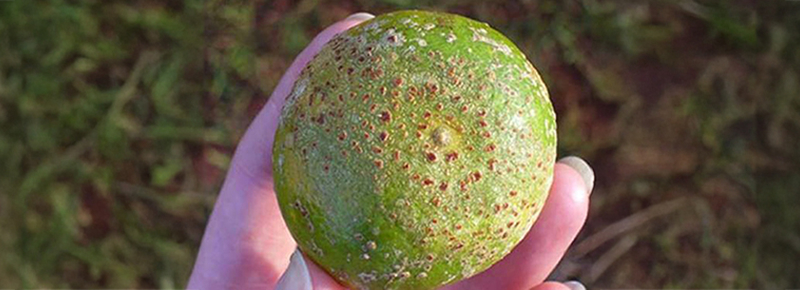
Sweet orange scab (SOS) is a cosmetic fungal disease that impacts the quality of the fruit and effects all citrus, not just oranges. SOS is caused by the fungus Elsinöe australis, which is dispersed by water. Fruit afflicted with SOS can be severely blemished and form pustules (small, raised spots or rounded swelling) and lesions on the skin or rind. Additionally, the disease can cause premature fruit drop, and stunt young trees and new backyard plantings.
Citrus Canker

Citrus canker causes citrus leaves and fruit to drop prematurely, and results in lesions on citrus leaves, stems and fruit. Fruit infected with the bacterium that causes citrus canker (Xanthomonas axonopodis) is safe to eat, but it may not be appetizing because of the lesions. While citrus canker is not harmful to people or animals, it can be found on numerous species of citrus and their hybrids. Hosts that are highly susceptible to the disease are grapefruit, Mexican lime, sweet lime, lemon and trifoliate orange.
Invasive Fruit Fly (IFF)

California has been experiencing an unusually high number of invasive fruit fly (IFF) detections – including the Mediterranean fruit fly, Oriental fruit fly, Queensland fruit fly and tau fruit fly. Notably, many of these IFF detections have triggered quarantines across numerous counties in California. The California Department of Food and Agriculture, in cooperation with the United States Department of Agriculture and County Agricultural Commissioners, has initiated local quarantines to eradicate and prevent the spread of these fruit fly species, as they are considered not established in California. Quarantines and their associated regulations are implemented to stop the artificial spread of these pests and thus avoid additional negative impacts to local communities, growers and the state’s agriculture and natural resources.

Oriental fruit fly

Mediterranean fruit fly

Queensland fruit fly

Tau fruit fly
Additional Pests and Diseases
California Department of Food and Agriculture (CDFA) staff routinely conduct multi-pest surveys across the state to monitor and manage various pests and diseases that could threaten the state's crops and natural resources. This comprehensive survey helps in early detection and provides vital data for implementing effective control measures to safeguard California's citrus trees. In addition to the pests and diseases mentioned above, the following are among the various species that CDFA will survey citrus trees for: